
From research to action: supporting young people in future crises
On 1 September 2026, we gathered at the Berner Generationenhaus in Bern for the final event of The Covid Generation, our three-year research project conducted within NRP80 “Covid-19 in Society”.
The event brought together researchers, policymakers and practitioners to reflect on what the Covid-19 pandemic has taught us about young people’s well-being and mental health – and how these lessons can help us prepare for future crises.
_______
💡 A few key messages stood out:
🔗 Build structures before a crisis occurs. Strong coordination across federal, cantonal and local levels — and between health, education and social policy — cannot be improvised during an emergency.
🌱 Invest in prevention and mental-health promotion. Preparedness starts in “normal” times by strengthening young people’s resources and competencies.
⚖️ Recognise diversity and gender differences. Crises do not affect all young people in the same way, and future responses need to reflect different situations and vulnerabilities.
🤝 Bring research, policy and practice together. Turning evidence into dialogue — and dialogue into action — is essential for better crisis preparedness.
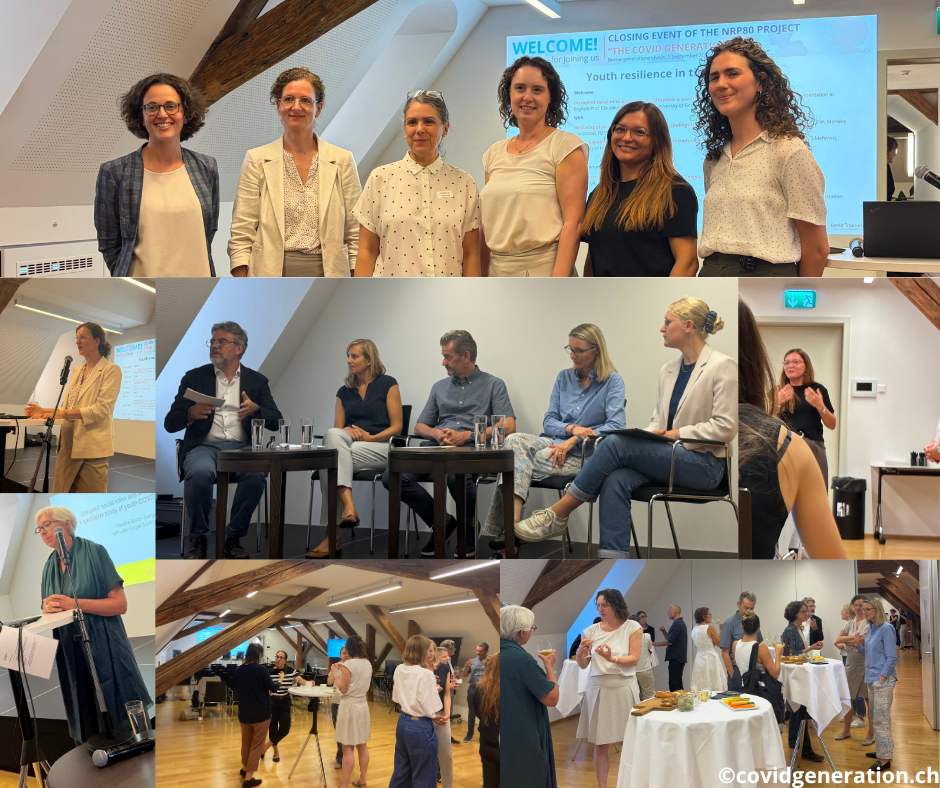
The programme combined findings from The Covid Generation, including insights from our policy report (availaible in French and German language), with broader perspectives on the psychosocial consequences of the pandemic for young people, including a presentation by Claudine Burton-Jeangros (University of Geneva).
Together, these contributions provided the starting point for a wider discussion about what research can teach us for future policy and practice.
The roundtable that followed – with Kerstin von Plessen (CHUV), Joanna Bärtschi (CDAS/SODK), Jann Schumacher (OFSP/BAG) and Elisa Ruch (Association
ZETA Movement) and expertly moderated by Xavier Pilloud (NRP80, Virtù Public Affairs) – brought research into dialogue with policy and practice.
The discussion highlighted several concrete challenges for future crisis preparedness. One was the importance of building structures and networks before a crisis occurs, rather than trying to establish them under emergency conditions. In Switzerland, this means strengthening coordination not only between federal, cantonal and local levels, but also across sectors – particularly health, education and social policy. Participants pointed to valuable initiatives and good practices already developed at cantonal and local level, while also stressing that resources and capacities differ across cantons.
This raises an important question for preparedness: who is responsible for what, and with which resources?
Another strong message concerned prevention and promotion. Preparedness is not only about having a crisis plan ready. It also means strengthening young people’s resources and competencies in “normal” times. Mental-health promotion and school-based prevention initiatives, for example, can provide important foundations that need to be sustained, strengthened and connected before the next crisis occurs.
Gender was another recurring theme throughout the discussion. The pandemic did not affect all young people in the same way, and gender can shape vulnerabilities as well as access to resources and support. Future policies and crisis responses therefore need to recognise gender differences, rather than treating young people as a homogeneous group. More broadly, preparedness needs to account for the diversity of situations and vulnerabilities within the younger population.
After three years of research, the final event was an opportunity not only to share what we have learned, but also to confront these findings with perspectives from policy and practice and ask what comes next. Our policy report brings together the project’s main findings and recommendations and contributes to a broader challenge:
How can we turn the lessons of Covid-19 into better preparedness – and better support for young people – when the next crisis comes?